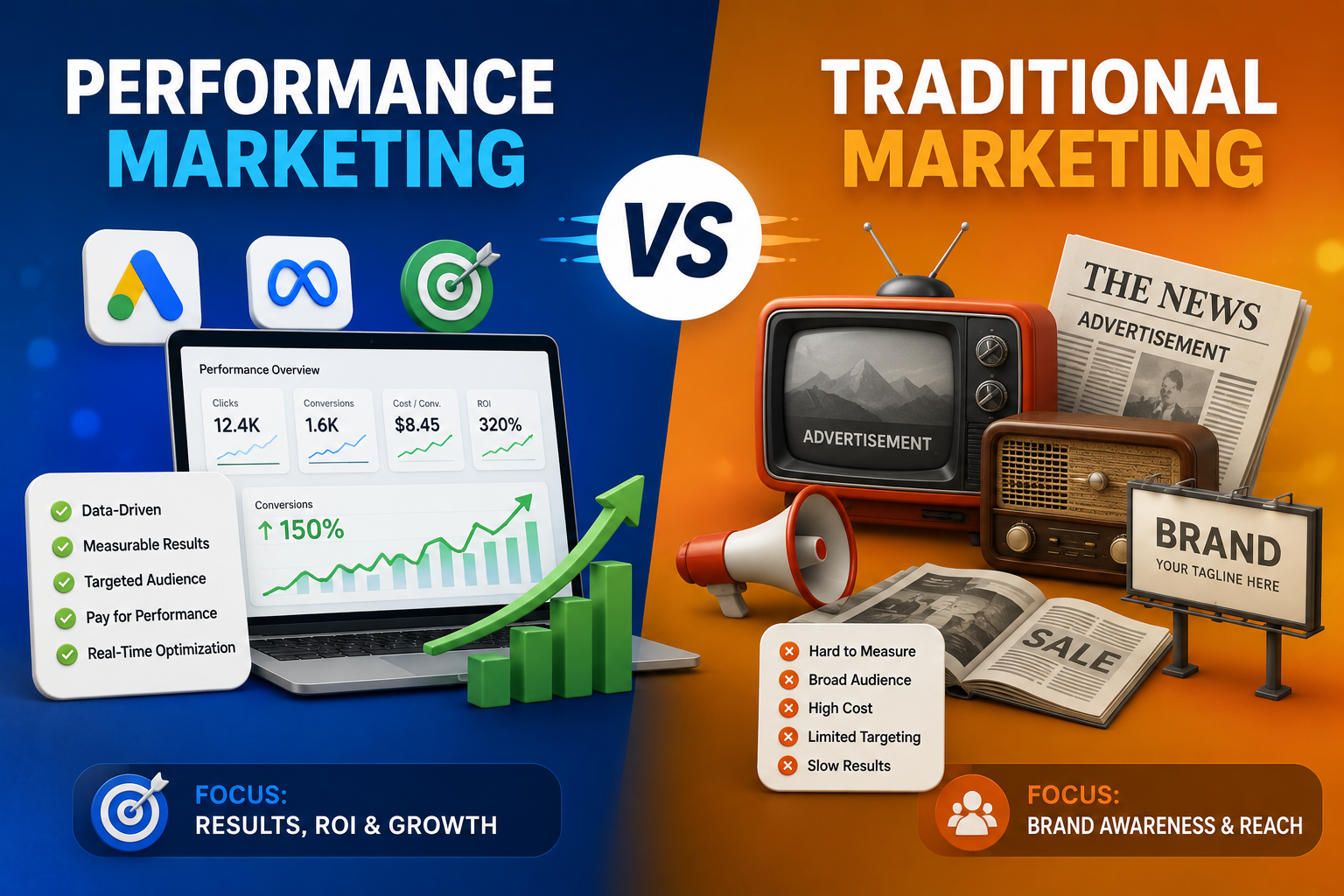
Marketing has evolved significantly over the past decade. Businesses today have more channels, tools, and technologies available than ever before. While traditional marketing methods such as television, radio, newspapers, and billboards continue to exist, digital-first strategies have transformed how brands connect with customers.
One of the most popular modern approaches is performance marketing, a results-driven model where businesses pay based on measurable actions such as clicks, leads, sales, or conversions. Unlike traditional marketing, performance marketing provides real-time data and precise targeting capabilities that help businesses maximize their advertising investments.
As organizations evaluate where to allocate their marketing budgets in 2026, a common question arises: Which approach works better—performance marketing or traditional marketing?
The answer depends on business objectives, target audiences, budget considerations, and desired outcomes. This article explores both approaches and helps businesses understand which strategy may deliver the greatest value.
Understanding Traditional Marketing
Traditional marketing refers to promotional activities conducted through offline channels.
Common examples include:
- Television advertising
- Radio advertising
- Newspaper advertisements
- Magazine placements
- Outdoor billboards
- Direct mail campaigns
- Event sponsorships
For decades, traditional marketing served as the primary method for building brand awareness and reaching mass audiences.
These channels remain effective for businesses seeking broad exposure and regional visibility.
Understanding Performance Marketing
Performance marketing is a digital advertising model focused on measurable outcomes.
Businesses pay for specific actions such as:
- Website visits
- Lead submissions
- Phone calls
- Product purchases
- App downloads
- Form completions
Popular performance marketing channels include:
- Search advertising
- Social media advertising
- Display advertising
- Remarketing campaigns
- Affiliate marketing
- Email marketing campaigns
The primary advantage is accountability. Every campaign can be measured, optimized, and refined based on actual results.
The Key Difference: Measurability
One of the biggest distinctions between the two approaches is measurement.
Traditional Marketing
Measuring exact performance can be challenging.
For example:
- How many customers purchased after seeing a billboard?
- Which radio advertisement generated a sale?
- What percentage of newspaper readers became customers?
While estimates are possible, precise tracking is often limited.
Performance Marketing
Digital campaigns provide detailed metrics, including:
- Impressions
- Clicks
- Conversions
- Cost per lead
- Return on investment
- Customer acquisition costs
Businesses gain immediate insights into campaign effectiveness and can make data-driven decisions.
Audience Targeting Capabilities
Targeting is another major differentiator.
Traditional Marketing
Traditional channels generally target broad audiences.
For example:
- Television advertisements reach large viewer groups.
- Billboards target geographic areas.
- Newspapers serve general readership audiences.
Although these methods generate awareness, they often reach many individuals outside the target market.
Performance Marketing
Digital platforms offer advanced targeting options based on:
- Demographics
- Interests
- Behaviors
- Search intent
- Location
- Device usage
This precision helps businesses focus budgets on audiences most likely to convert.
Cost Efficiency Comparison
Marketing budgets are valuable resources that must be allocated carefully.
Traditional Marketing Costs
Traditional campaigns often require significant investment for:
- Media placements
- Production expenses
- Print materials
- Broadcast distribution
These costs can make traditional advertising less accessible for small and medium-sized businesses.
Performance Marketing Costs
Performance marketing allows businesses to:
- Set flexible budgets
- Control spending
- Scale campaigns gradually
- Optimize based on performance
Since businesses can monitor results continuously, they can reduce waste and improve return on investment.
Speed of Results
The speed at which businesses receive feedback also differs significantly.
Traditional Marketing
Results may take weeks or months to evaluate.
Campaign adjustments often require:
- New creative production
- Updated media purchases
- Additional planning cycles
Performance Marketing
Digital campaigns provide immediate performance data.
Businesses can:
- Monitor results in real time
- Adjust budgets instantly
- Modify targeting settings
- Test creative variations
This flexibility allows marketers to improve outcomes much faster.
Brand Awareness vs Direct Conversions
Both approaches excel in different areas.
Traditional Marketing Strengths
Traditional marketing is particularly effective for:
- Mass awareness campaigns
- Regional brand visibility
- Broad audience reach
- Long-term brand recognition
Large-scale campaigns can create significant exposure and strengthen brand familiarity.
Performance Marketing Strengths
Performance marketing is ideal for:
- Lead generation
- Customer acquisition
- Sales growth
- Conversion optimization
- Revenue-focused campaigns
Businesses seeking measurable outcomes often prioritize performance-driven strategies.
Data-Driven Decision Making
Modern marketing success increasingly depends on data.
Performance marketing provides valuable insights such as:
- Customer behavior patterns
- Audience preferences
- Campaign effectiveness
- Conversion pathways
- Revenue attribution
These insights support continuous improvement and strategic decision-making.
Traditional marketing typically offers less granular performance data, making optimization more challenging.
The Role of Personalization
Today’s consumers expect personalized experiences.
Performance marketing enables businesses to deliver customized messaging based on:
- Search activity
- Website interactions
- Purchase history
- Audience interests
Personalized communication often improves engagement and conversion rates.
Traditional marketing generally relies on broader messaging designed to appeal to larger audiences.
When Traditional Marketing Still Makes Sense
Although digital marketing continues to grow, traditional channels remain valuable in certain situations.
Businesses may benefit from traditional marketing when:
- Building widespread brand awareness
- Reaching local audiences
- Supporting major product launches
- Targeting audiences with strong offline media consumption habits
For some industries, traditional advertising can complement digital efforts effectively.
Why Many Businesses Choose Performance Marketing
As competition increases and accountability becomes more important, businesses increasingly prioritize marketing strategies that demonstrate measurable value.
Performance marketing offers:
- Transparent reporting
- Better targeting
- Greater budget control
- Real-time optimization
- Improved lead generation
- Higher conversion potential
These advantages make it an attractive option for organizations seeking predictable and scalable growth.
Combining Both Strategies for Maximum Impact
The question is not always whether one approach is better than the other.
In many cases, the most effective strategy combines both methods.
For example:
- Traditional marketing builds awareness.
- Performance marketing captures demand and drives conversions.
Together, they can create a comprehensive marketing ecosystem that supports both visibility and revenue generation.
Businesses should evaluate their goals, audience behavior, and budget to determine the right balance.
The Future of Marketing in 2026
Marketing continues to shift toward measurable, data-driven strategies. Consumers increasingly interact with brands through digital channels, creating new opportunities for targeted engagement and performance optimization.
While traditional marketing retains value for brand-building initiatives, performance marketing is becoming the preferred choice for businesses focused on accountability, efficiency, and growth.
Organizations that leverage real-time insights and continuous optimization are better positioned to adapt to changing customer behaviors and market conditions.
Conclusion
Both traditional marketing and performance marketing offer unique advantages. Traditional marketing remains effective for broad awareness and mass-market exposure, while performance marketing excels at generating measurable results, qualified leads, and revenue growth.
For businesses seeking transparency, precise targeting, and improved return on investment, performance marketing often delivers greater flexibility and accountability. Its ability to track every stage of the customer journey makes it one of the most powerful marketing approaches available today.
Partnering with an experienced performance marketing agency can help businesses develop data-driven strategies that maximize visibility, improve conversion rates, and generate sustainable growth. EON8 helps organizations leverage performance marketing to achieve measurable business outcomes and long-term success.