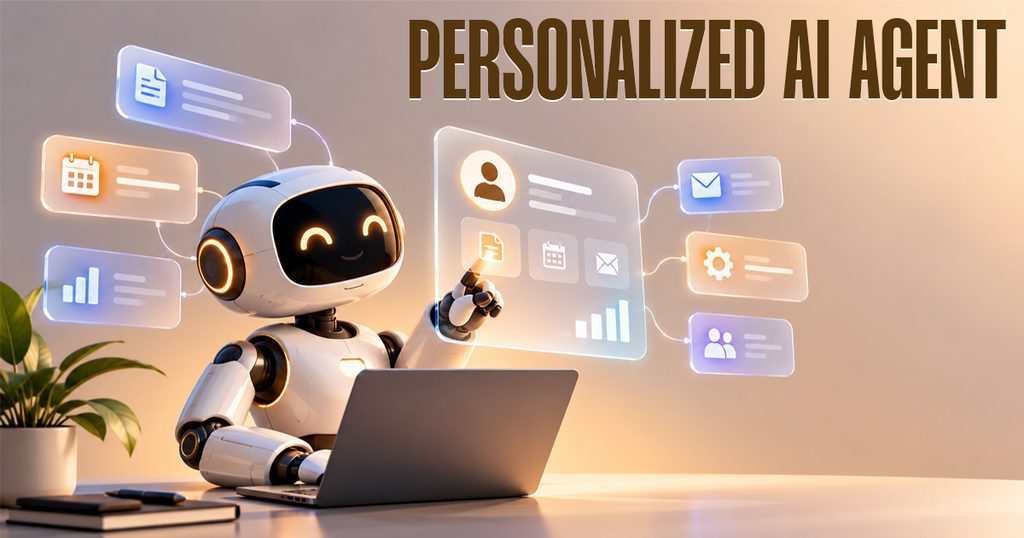
Businesses interact with different customers, employees, and partners every day. Each person has different needs, preferences, and expectations. Providing relevant assistance to everyone can become difficult when teams rely on generic responses and manual processes.
A personalized AI agent helps address this challenge by using relevant context, approved business information, and user preferences to provide more tailored assistance. Instead of responding to every request in the same way, it can adapt its responses and recommendations to the situation.
For businesses exploring AI adoption, personalized AI agent development offers an opportunity to improve customer interactions, simplify internal workflows, and make digital services more responsive to individual needs.
What Is a Personalized AI Agent?
A personalized AI agent is an AI-powered software assistant designed to provide responses or perform tasks based on a user’s context, preferences, and requirements.
Unlike a basic chatbot that primarily follows predefined question-and-answer patterns, a personalized AI agent can use approved information from previous interactions, business systems, and user instructions to deliver more relevant assistance.
For example, a customer support agent may use an authorised customer’s previous support history to understand an ongoing issue. An internal business agent may help an employee find information relevant to their role or prepare a report using approved company data.
The level of personalization depends on the system’s design, the information available, and the permissions granted. Personalization does not automatically mean that an AI agent learns independently from every conversation.
How Can Personalized AI Agents Help Businesses?
The value of a personalized AI agent depends on the problem it solves. Businesses should identify specific tasks where tailored assistance can improve the experience or reduce unnecessary manual work.
1. Personalized Customer Support
An AI agent can use approved customer records and interaction history to provide relevant responses. It may help answer routine questions, guide users through common processes, and direct complex requests to the appropriate support team.
This can reduce repetitive explanations while allowing human employees to focus on cases that require additional attention.
2. Sales Recommendations and Lead Assistance
Sales teams handle enquiries from customers at different stages of the buying journey. A personalized AI agent can help summarise previous interactions, identify relevant product or service information, and suggest appropriate follow-up actions.
Sales representatives remain responsible for reviewing recommendations and managing important customer conversations.
3. Employee Productivity
Employees frequently spend time searching documents, preparing summaries, and locating information across business applications.
An internal AI agent can help retrieve approved information, summarise documents, organise tasks, and assist with routine administrative work. Access permissions should ensure that employees only receive information they are authorised to view.
4. Personalized Digital Experiences
Businesses can use AI agents to provide more relevant guidance on websites, customer portals, and digital applications. For example, an agent may help users navigate services, understand available options, or locate information based on their stated requirements.
The aim is to make digital interactions more useful without collecting unnecessary personal information.
What Features Should a Personalized AI Agent Include?
The right features depend on the business objective, intended users, and available data.
Context-Aware Responses
The agent should understand the current request and use relevant information from the conversation or approved business sources. This helps reduce generic responses and unnecessary repetition.
User Preferences
Where appropriate and permitted, the agent can use saved preferences such as communication style, preferred language, or frequently selected options to tailor future interactions.
Users should have appropriate control over stored preferences and the ability to correct inaccurate information.
Business System Integration
Connecting the agent to relevant applications can help it retrieve current information or perform approved tasks. Depending on the use case, integrations may involve CRM systems, ERP platforms, internal knowledge bases, or customer support tools.
Access should be limited to the information and actions required for the agent’s intended purpose.
Workflow Automation
A personalized AI agent may assist with activities such as preparing summaries, creating draft responses, assigning requests, or generating task reminders. Actions that affect customers, finances, or business records may require human approval.
Multilingual Communication
For businesses serving diverse audiences, multilingual capabilities can help users interact in their preferred language. Responses should be tested for clarity, accuracy, and suitability for the intended audience.
Performance Monitoring
Businesses should measure whether the agent provides useful responses and completes its intended tasks reliably. Monitoring can include response accuracy, task completion, escalation rates, user feedback, and time saved.
How Does Personalized AI Agent Development Work?
Developing a useful AI agent requires more than selecting an AI model. The solution must be designed around a clear business requirement.
Step 1: Define the Use Case
Identify the specific problem the agent should solve. This might involve customer enquiries, employee knowledge retrieval, sales assistance, or repetitive administrative work.
Define measurable success criteria before development begins.
Step 2: Identify the Required Data
Determine which documents, records, and business applications the agent needs to access. Review data quality, ownership, access permissions, and any restrictions on personal or confidential information.
Step 3: Design the Agent’s Behaviour
Define how the agent should respond, when it should request clarification, which actions it can perform, and when it should hand a request to a human employee.
Clear boundaries help reduce incorrect responses and unintended actions.
Step 4: Select Models and Integration Methods
Choose suitable AI models, retrieval methods, APIs, and supporting technologies according to the use case. The architecture should balance performance, cost, security, and maintainability.
Step 5: Test with Realistic Scenarios
Test the agent using representative questions, incomplete information, unexpected requests, and situations where it should refuse or escalate a task.
Evaluate both the quality of responses and the reliability of any connected actions.
Step 6: Deploy and Improve
Launch the agent with appropriate monitoring and user guidance. Review feedback, investigate errors, update approved knowledge sources, and refine workflows as business needs change.
A limited pilot can help businesses validate the solution before extending it to additional teams or customer groups.
Why Privacy and Security Matter in Personalized AI
Personalization often involves using contextual information, making privacy and security important parts of development.
Businesses should consider the following safeguards:
- Data minimisation: Collect and use only the information required for the intended purpose.
- Access controls: Ensure the agent respects user permissions when retrieving information from connected systems.
- Secure data handling: Protect business and customer information during storage and transmission.
- Transparent usage: Explain what information is used and how it supports the service.
- Human oversight: Require review for sensitive decisions and high-impact actions.
- Ongoing testing: Check for inaccurate responses, inappropriate data disclosure, and unintended behaviour.
Businesses should also review applicable privacy requirements and their own data governance policies before deploying an AI agent.
Develop Personalized AI Agents with EON8
Every organisation has different customers, workflows, and operational requirements. A useful personalized AI agent should reflect those differences rather than provide the same generic experience to every user.
EON8 offers customized AI agent development services designed around business requirements, including personalized interactions and integrations with existing systems.
Businesses exploring this approach can discuss their goals, intended users, required integrations, and automation needs to identify an appropriate solution.
Visit EON8’s AI Agent Development Services to learn more about its capabilities and explore options for your business.
Build More Relevant and Useful AI Experiences
Personalized AI agents can help businesses deliver relevant assistance, reduce repetitive tasks, and improve interactions across digital channels. Their effectiveness depends on the quality of the underlying information, clear workflow design, appropriate integrations, and responsible data handling.
Start by identifying one well-defined business problem and testing whether an AI agent can solve it reliably. A focused implementation provides a practical foundation for evaluating performance and expanding personalization where it delivers measurable value.
Frequently Asked Questions
1. What is the main purpose of a personalized AI agent?
Its main purpose is to provide context-aware assistance or perform approved tasks based on a user’s needs, preferences, and available business information.
2. How is a personalized AI agent different from a chatbot?
A basic chatbot often follows predefined conversation flows. A personalized AI agent can use additional context, approved data sources, and connected tools to tailor responses and support more complex workflows.
3. Can a personalized AI agent integrate with existing business software?
Yes. Depending on the software and available integration methods, an AI agent can connect with CRM platforms, ERP systems, internal databases, knowledge bases, and customer support applications.
4. Is personal data required to build a personalized AI agent?
Not always. Some agents can personalise interactions using session context, role-based information, or user-selected preferences. Any personal data used should be necessary for the intended purpose and handled appropriately.
5. How long does personalized AI agent development take?
The timeline depends on the complexity of the use case, data preparation, integrations, security requirements, and testing. A focused prototype may take less time than a production-ready agent connected to multiple business systems.
6. How can businesses measure the success of a personalized AI agent?
Businesses can track task completion, response accuracy, user satisfaction, reduced handling time, escalation rates, and the amount of manual work avoided. Metrics should reflect the specific business objective.